Pumping, inspection, repair, and full installation across Deltona and West Volusia. Written pricing before the work starts.
Call (555) 555-5555Or call — we answer. No obligation, honest advice.
Florida septic is a different animal, and Deltona is where you see it most clearly. Two things drive everything here: a seasonal water table that rises and falls on its own schedule, and sandy soil that percolates fast but filters less than heavier ground does. Put those together and a drain field has less unsaturated soil to work with exactly when it needs the most. That is why mound and elevated systems exist in this part of the state, and why advice imported from a clay-soil market gets Florida wrong.
Deltona was platted in the 1960s as sprawling residential blocks, and sewer never fully caught up. The result is a city of nearly a hundred thousand people still running largely on septic - tens of thousands of tanks, a great many of them original to their houses. From Saxon Boulevard to Howland, Providence to Doyle Road, and out through DeBary, Orange City, Enterprise, Osteen, and Lake Helen, this is one of the largest septic-served landscapes in Florida. An older system is not automatically a failing system, but a system from 1972 has earned somebody looking at it honestly.
The idea behind this service is simple. Locate the system, look at it honestly, show you what we found with photos before you ever see a price, and put the price in writing. Diagnosis first, quote second, work third. Sometimes the best service call is the one we talk you out of.
Most septic work is excavation, and on Deltona's original-construction lots the first challenge is often just finding the lids, which have spent decades disappearing under St. Augustine grass. Locating a tank, opening a lid, exposing a line, or setting a new field all start with breaking ground, and how that gets done decides what your yard looks like afterward.
Ground mats go down where a truck has to cross a lawn, irrigation heads and pet fences get flagged before anything is dug, gates get closed behind us, and lids get seated properly. If we had to dig to find your lids, ask about risers - it is a one-time cost that ends that dig fee permanently.

Four services cover almost everything a residential system in West Volusia needs, whether the system went in last year or in 1970.
Complete pump-outs on a three-to-five-year cycle. We uncover the lids, pump fully - liquid, sludge and scum - inspect the baffles, and hand you a written condition report every time.
Closing-ready reports for buyers and sellers. Tank and sludge levels, baffle and tee integrity, pump and alarm operation, drain field surface, and seasonal water-table context.
New builds and replacements engineered for Florida ground, including mound and elevated systems, plus repairs to baffles, pumps, lines and fields. Permitting handled.
A septic tank holds solids in two forms: sludge that settles to the bottom, and a scum mat that floats on top. Between them sits the relatively clear effluent that is supposed to be the only thing leaving for the drain field. When the sludge layer gets deep enough, solids carry over into the field, and once a field is clogged with solids it does not recover.
Florida adds a second constraint that the national advice tends to skip. A drain field does its real work in the unsaturated soil beneath the trenches, where the effluent finishes being treated before it reaches groundwater. When the seasonal water table comes up, that working layer gets thinner, and a field that handles everything easily in April can struggle in September. This is the whole reason elevation requirements and mound systems exist here.
Sandy soil is the other half of the story, and it cuts both ways. Water moves through it quickly, which is good for drainage and bad for filtration, so the design has to provide enough separation to do the treatment the soil will not do on its own. Timing follows from all of it. Most households run three to five years between pumpings, and around here it is worth leaning toward the early end, because a full tank meeting a saturated field is how a slow problem becomes a fast one.

Systems here decline slowly and then fail all at once. What arrives as an emergency is usually a decade of skipped pumping landing in one week. The tank exists to hold solids and release clear liquid; when solids outgrow that capacity they leave with the liquid, and no additive brings a fouled field back.
Which leaves one rule worth keeping: pumping is inexpensive and drain fields are not. Every pump-out defends the trenches - and in Florida, rebuilding a field can mean raising it to meet today's elevation requirements rather than simply replacing what 1970 permitted.
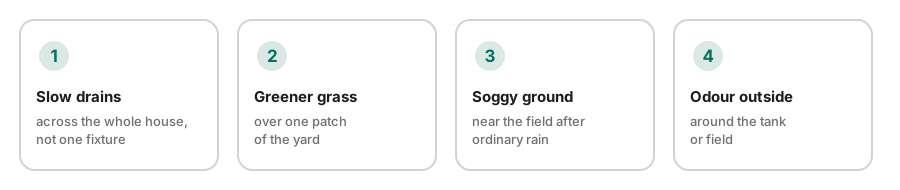
The warning signs are the usual ones: drains that gurgle or slow across the whole house rather than one fixture, grass growing greener over one part of the yard, a soggy stripe over the field after ordinary rain, a smell outside near the tank or field. But Deltona has a diagnostic tell all its own, and it is worth knowing. If your drains act up every summer and then settle down once the dry season arrives, that seasonal pattern is information. It usually points at the water table competing with your field for the same soil rather than at a field that has died - and those two situations look similar from the driveway while costing wildly different amounts to fix.
A handful of habits quietly shave years off a system. Wipes, which flush without trouble and then persist. Bleach and drain chemicals in quantity, killing the bacteria the tank depends on. Traffic across the field, compacting ground and crushing lines. Gutters or drains discharging at the trenches, adding water the field was never sized for. And around here, oak roots - patient, thirsty, and perfectly capable of finding a line.
None of these mean disaster on their own. All of them are cheaper to look at than to ignore.
Every job runs the same way, whether it is a routine pump-out or a full elevated-system install. Here is the standard you can hold us to.
You get the number before work starts, not after. Our rates do not own a calendar - a rainy-season call is priced like any other. If we open the lid and find something else going on, we stop, show you, and quote it separately.
You get a real window and a call when the crew is on the way. With this many aging systems and this few crews in West Volusia, a returned call and a kept window are half the service.
If someone has told you the whole system has failed, get another set of eyes on it. We will tell you plainly when a field is finished - and just as plainly when it is not.
Deltona is one of Central Florida's most active affordable markets, and a large share of its houses sit on original septic systems. That combination makes a septic inspection less of a formality than it is almost anywhere else: a failed field on a 1970s system is a five-figure surprise, and no buyer should inherit one blind.
For buyers, the inspection should happen early enough in the contract period to leave room to negotiate. What gets checked matters as much as whether it happens: locating and opening the tank, measuring sludge and scum against capacity, confirming baffles and tees, testing the pump and alarm where present, and probing the field for saturation. In Florida the report should also put the system in seasonal context, because a field inspected in the dry season is being seen on its best behavior.
For sellers, having this done before listing turns an unknown the buyer's agent can push against into documentation, and it answers the scariest question before it gets asked. Plenty of buyers here are first-time septic owners who have only ever had a sewer bill, so we write reports to be readable by someone seeing their first tank. If you have a closing date set, say so when you call, because scheduling works differently with a deadline attached.
Deltona is the base, and the service area covers West Volusia - Deltona Lakes, Stone Island, and Sterling Park, out through DeBary, Orange City, Enterprise, Osteen, Lake Helen, Cassadaga, and up toward DeLand. Zip codes 32725, 32738, 32713 and their neighbors are all regular ground. Sewer reaches parts of this landscape; across most of it, septic is the long-term reality and worth maintaining properly.
Travel time is part of the quote on the far edges, and we will tell you that on the phone rather than adding it to the invoice afterward. If you are just outside the list below, it is still worth calling.

Septic in Florida is governed by state-level onsite sewage rules rather than by each county writing its own, and those rules include elevation and setback requirements that simply do not exist in most states. They exist because of the water table. How high the seasonal high water rises on your particular lot determines how deep a system can sit, and therefore whether you need a conventional field, a mound, or another elevated design.
That is also why an honest install quote follows a site and water-table evaluation instead of preceding it. Any company willing to price a new system before anyone has looked at where the water sits on your lot is improvising with your money. Replacing one of Deltona's original systems has an added wrinkle worth knowing early: today's rules are not the rules those systems were built under, so a replacement often has to be designed and elevated to a standard the original never met.
For a homeowner that mostly means one less thing to worry about. You do not need to know your seasonal high water elevation or what the permitting office wants to see. You call, we evaluate the ground, and the paperwork gets handled by people who work Florida systems rather than treating this like anywhere else.
Nobody should learn septic pricing during an emergency, so here is the calm-day version: pumping tracks tank size, lid depth, and access, which is why buried original-construction lids cost more to reach and why risers pay for themselves. Repairs price by component, from cheap floats and baffles through pumps and lines up to serious field work. Installations carry Florida's special variable, the water table - where seasonal high water calls for a mound or elevated design, the cost rises with the engineering.
One local caution worth stating plainly: after a tropical system passes, saturated ground produces a wave of septic distress across the county, and that surge attracts opportunistic pricing. It is worth getting in the queue early, and worth being skeptical of a quote that arrived with the storm. Call (555) 555-5555 and we will tell you what your system actually needs, including when the honest answer is nothing yet.
Tell us what you need and we'll get back to you with a real answer. If it's an active backup or standing water over the field, calling gets you a faster response.
Call: (555) 555-5555
Area: Deltona, FL and Volusia County